
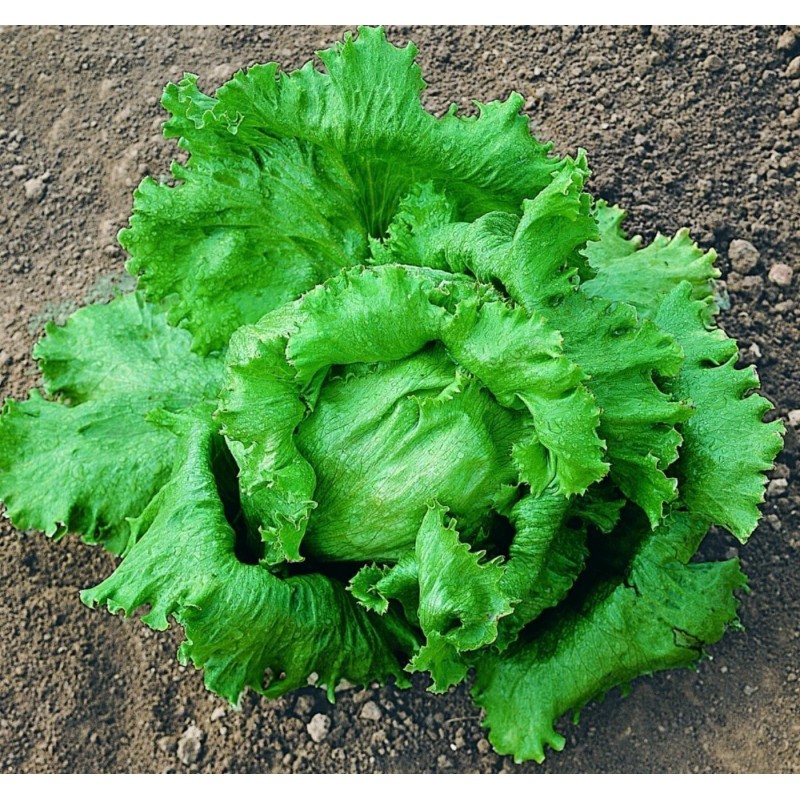
Brasiliana: Similar in nature to an Iceberg lettuce. Large, tightly wrapped head with crunchy leaves. Lettuce (Lactuca sativa) is an annual plant of the daisy family Asteraceae. It is most often grown
Brasiliana: Similar in nature to an Iceberg lettuce. Large, tightly wrapped head with crunchy leaves.
Lettuce (Lactuca sativa) is an annual plant of the daisy family Asteraceae. It is most often grown as a leaf vegetable, but sometimes for its stem and seeds. Lettuce was first cultivated by the ancient Egyptians who turned it from a weed, whose seeds were used to produce oil, into a food plant grown for its succulent leaves, in addition to its oil-rich seeds. Lettuce spread to the Greeks and Romans, the latter of whom gave it the name lactuca, from which the English lettuce is ultimately derived. By 50 AD, multiple types were described, and lettuce appeared often in medieval writings, including several herbals. The 16th through 18th centuries saw the development of many varieties in Europe, and by the mid-18th century cultivars were described that can still be found in gardens. Europe and North America originally dominated the market for lettuce, but by the late 20th century the consumption of lettuce had spread throughout the world.
Generally grown as a hardy annual, lettuce is easily cultivated, although it requires relatively low temperatures to prevent it from flowering quickly. It can be plagued with numerous nutrient deficiencies, as well as insect and mammal pests and fungal and bacterial diseases. L. sativa crosses easily within the species and with some other species within the Lactuca genus; although this trait can be a problem to home gardeners who attempt to save seeds, biologists have used it to broaden the gene pool of cultivated lettuce varieties. World production of lettuce and chicory for calendar year 2010 stood at 23 620 000/23,620,000 tonnes, half of which came from China.
Lettuce is most often used for salads, although it is also seen in other kinds of food, such as soups, sandwiches and wraps; it can also be grilled.[3] One variety, the woju (莴苣), or asparagus lettuce, is grown for its stems, which are eaten either raw or cooked. Lettuce is a rich source of vitamin K and vitamin A, and is a moderate source of folate and iron. Contaminated lettuce is often a source of bacterial, viral and parasitic outbreaks in humans, including E. coli and Salmonella. In addition to its main use as a leafy green, it has also gathered religious and medicinal significance over centuries of human consumption.
Taxonomy and etymology
Lactuca sativa is a member of the Lactuca (lettuce) genus and the Asteraceae (sunflower or aster) family.[4] The species was first described in 1753 by Carl Linnaeus in the second volume of his Species Plantarum.[5] Synonyms for L. sativa include Lactuca scariola var. sativa,[1] L. scariola var. integrata and L. scariola var. integrifolia.[6] L. scariola is itself a synonym for L. serriola, the common wild or prickly lettuce.[2] L. sativa also has many identified taxonomic groups, subspecies and varieties, which delineate the various cultivar groups of domesticated lettuce.[7] Lettuce is closely related to several Lactuca species from southwest Asia; the closest relationship is to L. serriola, an aggressive weed common in temperate and subtropical zones in much of the world.
The Romans referred to lettuce as lactuca (lac meaning milk in Latin), an allusion to the white substance, now called latex, exuded by cut stems.[9] This word has become the genus name, while sativa (meaning "sown" or "cultivated") was added to create the species name.[10] The current word lettuce, originally from Middle English, came from the Old French letues or laitues, which derived from the Roman name.[11] The name romaine came from that type's use in the Roman papal gardens, while cos, another term for romaine lettuce, came from the earliest European seeds of the type from the Greek island of Cos, a center of lettuce farming in the Byzantine period.
Description
Lettuce's native range spreads from the Mediterranean to Siberia, although it has been transported to almost all areas of the world. Plants generally have a height and spread of 6 to 12 inches (15 to 30 cm). The leaves are colorful, mainly in the green and red color spectrums, with some variegated varieties. There are also a few varieties with yellow, gold or blue-teal leaves. Lettuces have a wide range of shapes and textures, from the dense heads of the iceberg type to the notched, scalloped, frilly or ruffly leaves of leaf varieties.[14] Lettuce plants have a root system that includes a main taproot and smaller secondary roots. Some varieties, especially those found in the United States and Western Europe, have long, narrow taproots and a small set of secondary roots. Longer taproots and more extensive secondary systems are found in varieties from Asia.
Depending on the variety and time of year, lettuce generally lives 65–130 days from planting to harvesting. Because lettuce that flowers (through the process known as "bolting") becomes bitter and unsaleable, plants grown for consumption are rarely allowed to grow to maturity. Lettuce flowers more quickly in hot temperatures, while freezing temperatures cause slower growth and sometimes damage to outer leaves.[16] Once plants move past the edible stage, they develop flower stalks up to 3 feet (0.9 m) high with small yellow blossoms.[17] Like other members of the tribe Cichorieae, lettuce inflorescences (also known as flower heads or capitula) are composed of multiple florets, each with a modified calyx called a pappus (which becomes the feathery "parachute" of the fruit), a corolla of five petals fused into a ligule or strap, and the reproductive parts. These include fused anthers that form a tube which surrounds a style and bipartite stigma. As the anthers shed pollen, the style elongates to allow the stigmas, now coated with pollen, to emerge from the tube.[15][18] The ovaries form compressed, obovate (teardrop-shaped) dry fruits that do not open at maturity, measuring 3 to 4 mm long. The fruits have 5–7 ribs on each side and are tipped by two rows of small white hairs. The pappus remains at the top of each fruit as a dispersal structure. Each fruit contains one seed, which can be white, yellow, gray or brown depending on the variety of lettuce.
The domestication of lettuce over the centuries has resulted in several changes through selective breeding: delayed bolting, larger seeds, larger leaves and heads, better taste and texture, a lower latex content, and different leaf shapes and colors. Work in these areas continues through the present day.[19] Scientific research into the genetic modification of lettuce is ongoing, with over 85 field trials taking place between 1992 and 2005 in the European Union and United States to test modifications allowing greater herbicide tolerance, greater resistance to insects and fungi and slower bolting patterns. However, genetically modified lettuce is not currently used in commercial agriculture.
History
Lettuce was first cultivated in ancient Egypt for the production of oil from its seeds. This plant was probably selectively bred by the Egyptians into a plant grown for its edible leaves,[21] with evidence of its cultivation appearing as early as 2680 BC.[9] Lettuce was considered a sacred plant of the reproduction god Min, and it was carried during his festivals and placed near his images. The plant was thought to help the god "perform the sexual act untiringly."[22] Its use in religious ceremonies resulted in the creation of many images in tombs and wall paintings. The cultivated variety appears to have been about 30 inches (76 cm) tall and resembled a large version of the modern romaine lettuce. These upright lettuces were developed by the Egyptians and passed to the Greeks, who in turn shared them with the Romans. Circa 50 AD, Roman agriculturalist Columella described several lettuce varieties – some of which may have been ancestors of today's lettuces.
Lettuce appears in many medieval writings, especially as a medicinal herb. Hildegard of Bingen mentioned it in her writings on medicinal herbs between 1098 and 1179, and many early herbals also describe its uses. In 1586, Joachim Camerarius provided descriptions of the three basic modern lettuces – head lettuce, loose-leaf lettuce, and romaine (or cos) lettuce.[12] Lettuce was first brought to the Americas from Europe by Christopher Columbus in the late 15th century.[23][24] Between the late 16th century and the early 18th century, many varieties were developed in Europe, particularly Holland. Books published in the mid-18th and early 19th centuries describe several varieties found in gardens today.
Due to its short lifespan after harvest, lettuce was originally sold relatively close to where it was grown. The early 20th century saw the development of new packing, storage and shipping technologies that improved the lifespan and transportability of lettuce and resulted in a significant increase in availability.[26] During the 1950s, lettuce production was revolutionized with the development of vacuum cooling, which allowed field cooling and packing of lettuce, replacing the previously used method of ice-cooling in packing houses outside the fields.
Lettuce is very easy to grow, and as such has been a significant source of sales for many seed companies. Tracing the history of many varieties is complicated by the practice of many companies, particularly in the US, of changing a variety's name from year to year. This was done for several reasons, the most prominent being to boost sales by promoting a "new" variety or to prevent customers from knowing that the variety had been developed by a competing seed company. Documentation from the late 19th century shows between 65 and 140 distinct varieties of lettuce, depending on the amount of variation allowed between types – a distinct difference from the 1,100 named lettuce varieties on the market at the time. Names also often changed significantly from country to country.[28] Although most lettuce grown today is used as a vegetable, a minor amount is used in the production of tobacco-free cigarettes; however, domestic lettuce's wild relatives produce a leaf that visually more closely resembles tobacco.
Cultivation
A hardy annual, some varieties of lettuce can be overwintered even in relatively cold climates under a layer of straw, and older, heirloom varieties are often grown in cold frames.[25] Lettuces meant for the cutting of individual leaves are generally planted straight into the garden in thick rows. Heading varieties of lettuces are commonly started in flats, then transplanted to individual spots, usually 8 to 14 inches (20 to 36 cm) apart, in the garden after developing several leaves. Lettuce spaced further apart receives more sunlight, which improves color and nutrient quantities in the leaves. Pale to white lettuce, such as the centers in some iceberg lettuce, contain few nutrients.
Lettuce grows best in full sun in loose, nitrogen-rich soils with a pH of between 6.0 and 6.8. Heat generally prompts lettuce to bolt, with most varieties growing poorly above 75 °F (24 °C); cool temperatures prompt better performance, with 60 to 65 °F (16 to 18 °C) being preferred and as low as 45 °F (7 °C) being tolerated.[30] Plants in hot areas that are provided partial shade during the hottest part of the day will bolt more slowly. Temperatures above 80 °F (27 °C) will generally result in poor or non-existent germination of lettuce seeds.[30] After harvest, lettuce lasts the longest when kept at 32 °F (0 °C) and 96 percent humidity. Lettuce quickly degrades when stored with fruit such as apples, pears and bananas that release the ripening agent ethylene gas. The high water content of lettuce (94.9 percent) creates problems when attempting to preserve the plant – it cannot be successfully frozen, canned or dried and must be eaten fresh.
Lettuce varieties will cross with each other, making spacing of 5 to 20 feet (1.5 to 6.1 m) between varieties necessary to prevent contamination when saving seeds. Lettuce will also cross with Lactuca serriola (wild lettuce), with the resulting seeds often producing a plant with tough, bitter leaves. Celtuce, a lettuce variety grown primarily in Asia for its stems, crosses easily with lettuces grown for their leaves.[17] This propensity for crossing, however, has led to breeding programs using closely related species in Lactuca, such as L. serriola, L. saligna, and L. virosa, to broaden the available gene pool. Starting in the 1990s, such programs began to include more distantly related species such as L. tatarica.[32] Seeds keep best when stored in cool conditions, and, unless stored cryogenically, remain viable the longest when stored at −4 °F (−20 °C); they are relatively short lived in storage.
At room temperature, lettuce seeds remain viable for only a few months. However, when newly harvested lettuce seed is stored cryogenically, this life increases to a half-life of 500 years for vaporized nitrogen and 3,400 years for liquid nitrogen; this advantage is lost if seeds are not frozen promptly after harvesting.
Culinary use
As described around 50 AD, lettuce leaves were often cooked and served by the Romans with an oil-and-vinegar dressing; however, smaller leaves were sometimes eaten raw. During the 81–96 AD reign of Domitian, the tradition of serving a lettuce salad before a meal began. Post-Roman Europe continued the tradition of poaching lettuce, mainly with large romaine types, as well as the method of pouring a hot oil and vinegar mixture over the leaves.[9] Today, the majority of lettuce is grown for its leaves, although one type is grown for its stem and one for its seeds, which are made into an oil.[21] Most lettuce is used in salads, either alone or with other greens, vegetables, meats and cheeses. Romaine lettuce is often used for Caesar salads, with a dressing that includes anchovies and eggs. Lettuce leaves can also be found in soups, sandwiches and wraps, while the stems are eaten both raw and cooked.[10] The consumption of lettuce in China developed differently from in Western countries, due to health risks and cultural aversion to eating raw leaves. In that country, "salads" were created from cooked vegetables and served hot or cold. Lettuce was also used in a larger variety of dishes than in Western countries, contributing to a range of dishes including bean curd and meat dishes, soups and stir-frys plain or with other vegetables. Stem lettuce, widely consumed in China, is eaten either raw or cooked, the latter primarily in soups and stir-frys.[44] Lettuce is also used as a primary ingredient in the preparation of lettuce soup.
Nutritional content
Depending on the variety, lettuce is an excellent source (20% of the Daily Value, DV, or higher) of vitamin K (97% DV) and vitamin A (21% DV) (table), with higher concentrations of the provitamin A compound, beta-carotene, found in darker green lettuces, such as Romaine.[31] With the exception of the iceberg variety, lettuce is also a good source (10-19% DV) of folate and iron (table).
Religious and medicinal lore
In addition to its usual purpose as an edible leafy vegetable, lettuce has had a number of uses in ancient (and even some more modern) times as a medicinal herb and religious symbol. For example, ancient Egyptians thought lettuce to be a symbol of sexual prowess[43] and a promoter of love and childbearing in women. The Romans likewise claimed that it increased sexual potency.[52] In contrast, the ancient Greeks connected the plant with male impotency,[9] and served it during funerals (probably due to its role in the myth of Adonis's death), and British women in the 19th century believed it would cause infertility and sterility. Lettuce has mild narcotic properties; it was called "sleepwort" by the Anglo-Saxons because of this attribute, although the cultivated L. sativa has lower levels of the narcotic than its wild cousins.[52] This narcotic effect is a property of two sesquiterpene lactones which are found in the white liquid (latex) in the stems of lettuce,[29] called lactucarium or "lettuce opium".
Lettuce is also eaten as part of the Jewish Passover Seder, where it is considered the optimal choice for use as the bitter herb, which is eaten together with the matzah.
Some American settlers claimed that smallpox could be prevented through the ingestion of lettuce,[52] and an Iranian belief suggested consumption of the seeds when afflicted with typhoid.[53] Folk medicine has also claimed it as a treatment for pain, rheumatism, tension and nervousness, coughs and insanity; scientific evidence of these benefits in humans has not been found. The religious ties of lettuce continue into the present day among the Yazidi people of northern Iraq, who have a religious prohibition against eating the plant.
 Reviews (0)
Brasiliana: Similar in nature to an Iceberg lettuce. Large, tightly wrapped head with crunchy leaves. Lettuce (Lactuca sativa) is an annual plant of the daisy family Asteraceae. It is most often grown