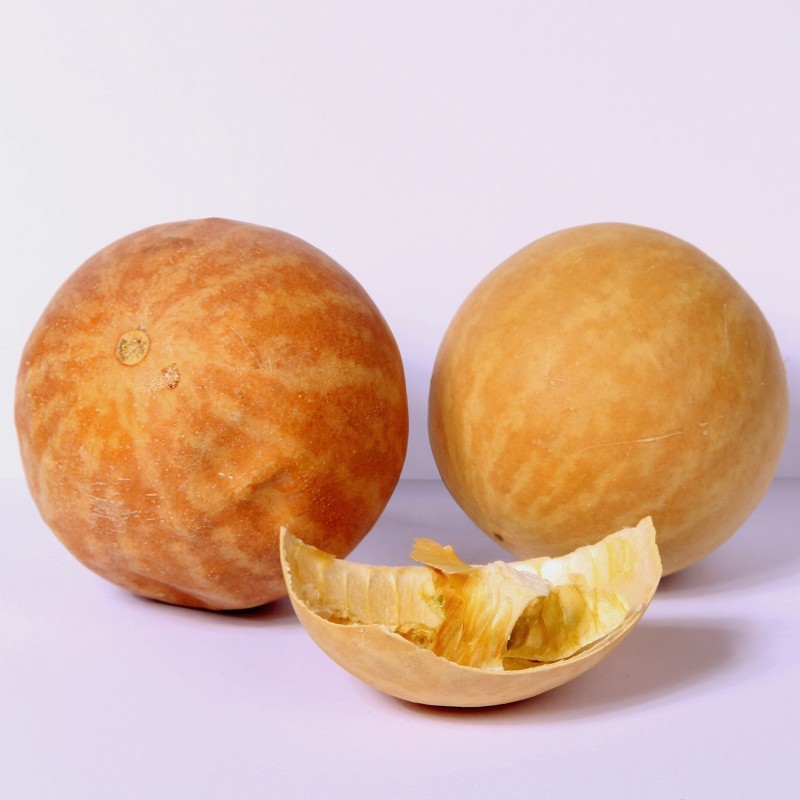
Desert Gourd, Colocynth Seeds (Citrullus colocynthis)
Price for Package of 5 (0.13g), 40 (1g) seeds.
Citrullus colocynthis, with many common names including colocynth, bitter apple, bitter cucumber, desert gourd,[citation needed] egusi, vine of Sodom, or wild gourd, is a desert viny plant native to the
Dear Customers,
We would like to inform you about an important change regarding payment fees. Unfortunately, due to the exceptionally high transaction fees imposed by PayPal, we are forced to apply a surcharge for payments made through their service.
However, we have a solution for you! You can avoid these astronomical fees by choosing one of our alternative payment methods with ZERO COMMISSION:
✅ Credit/Debit Card Payment – 0% Fee ✅ Bank Transfer – 0% Fee
To take advantage of these savings, please complete your purchase directly through our official website: 👉
Thank you for your understanding and for choosing our seeds!
Your Seeds Gallery Team
Desert Gourd, Colocynth Seeds (Citrullus colocynthis)
Price for Package of 5 (0.13g), 40 (1g) seeds.
Citrullus colocynthis, with many common names including colocynth, bitter apple, bitter cucumber, desert gourd,[citation needed] egusi, vine of Sodom, or wild gourd, is a desert viny plant native to the Mediterranean Basin and Asia, especially Turkey (especially in regions such as İzmir), and Nubia.
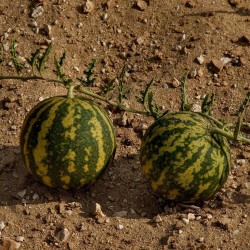
It resembles a common watermelon vine, but bears small, hard fruits with a bitter pulp. It originally bore the scientific name Colocynthis citrullus.
Origin, distribution, and ecology
- colocynthis is a desert viny plant that grows in sandy, arid soils. It is native to the Mediterranean Basin and Asia, and is distributed among the west coast of northern Africa, eastward through the Sahara, Egypt until India, and reaches also the north coast of the Mediterranean and the Caspian Seas. It grows also in southern European countries as in Spain and on the islands of the Grecian archipelago. On the island of Cyprus, it is cultivated on a small scale; it has been an income source since the 14th century and is still exported today. It is an annual or a perennial plant (in wild) in Indian arid zones and has a great survival rate under extreme xeric conditions.[4] In fact, it can tolerate annual precipitation of 250 to 1500 mm and an annual temperature of 14.8 to 27.8 °C. It grows from sea level up to 1500 meters above sea level on sandy loam, subdesert soils, and sandy sea coasts with a pH range between 5.0 and 7.8.
Characteristics and morphology
Roots and stems
The roots are large, fleshy, and perennial, leading to a high survival rate due to the long tap root. The vine-like stems spread in all directions for a few meters looking for something over which to climb. If present, shrubs and herbs are preferred and climbed by means of axiliary branching tendrils.[4]
Leaves
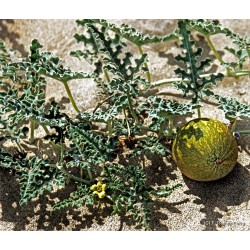
Very similar to watermelon, the leaves are palmate and angular with three to seven divided lobes.
Flowers
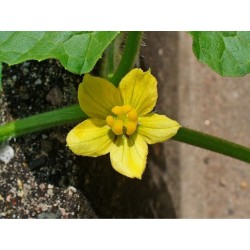
The flowers are yellow and solitary in the axes of leaves and are borne by yellow-greenish peduncles. Each has a subcampanulated five-lobed corolla and a five-parted calyx. They are monoecious, so the male (stamens) and the female reproductive parts (pistils and ovary) are borne in different flowers on the same plant. The male flowers’ calyx is shorter than the corolla. They have five stamens, four of which are coupled and one is single with monadelphous anther. The female flowers have three staminoids and a three-carpel ovary. The two sexes are distinguishable by observing the globular and hairy inferior ovary of the female flowers.[4]
Fruits
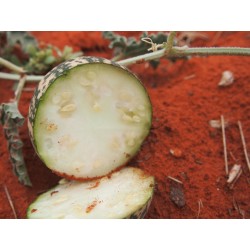
The fruit is smooth, spheric with a 5– to 10-cm-diameter and extremely bitter taste. The calyx englobe the yellow-green fruit which becomes marble (yellow stripes) at maturity. The mesocarp is filled with a soft, dry, and spongy white pulp, in which the seeds are embedded. Each of the three carpels bears six seeds. Each plant produces 15 to 30 fruits.[5]
Seeds
The seeds are grey and 5 mm long by 3 mm wide. They are edible but similarly bitter, nutty-flavored, and rich in fat and protein. They are eaten whole or used as an oilseed. The oil content of the seeds is 17–19% (w/w), consisting of 67–73% linoleic acid, 10–16% oleic acid, 5–8% stearic acid, and 9–12% palmitic acid. The oil yield is about 400 l/hectare.[6] In addition, the seeds contain a high amount of arginine, tryptophan, and the sulfur-containing amino acids.[7]
Cultivation
- colocynthis, a perennial plant, can propagate both by generative and vegetative means. However, seed germination is poor due to the extreme xeric conditions, so vegetative propagation is more common and successful in nature. In the Indian arid zone, growth takes place between January and October, but the most favorable period for the vegetative growth is during summer, which coincides with the rainy season. Growth declines as soon as the rains and the temperature decrease and almost stops during the cold and dry months of December and January. Colocynth prefers sandy soils and is a good example of good water management which may be useful also on research to better understand how desert plants react to water stress.[8][9] To enhance production, an organic fertilizer can be applied.[10] Colocynth is also commonly cultivated together with cassava (intercropping) in Nigeria.
Cultivated colocynth suffers of climatic stress and diseases such as cucumber mosaic virus, melon mosaic virus, Fusarium wilt, etc. as any other crop. To improve it, a relatively new protocol for regeneration has been developed with the aim of incorporating disease and stress resistance to increase yield potential and security avoiding interspecific hybridization barriers.[11]
Uses
- colocynthis can be eaten or elaborated for further uses in medicine and as energy source, e.g. oilseed and biofuel. The characteristic small seed of the colocynth have been found in several early archeological sites in northern Africa and the Near East, specifically at Neolithic Armant, Nagada in Egypt; at sites dating from 3800 BC to Roman times in Libya; and the prepottery Neolithic levels of the Nahal Hemar caves in Israel.[12] Zohary and Hopf speculate, "these finds indicate that the wild colocynth was very probably used by humans prior to its domestication."[12]
Traditional medicine and research
Colocynth has been widely used in traditional medicine for centuries.[13] In premodern medicine, it was an ingredient in the electuary called confectio hamech, or diacatholicon, and other laxative pills.[14]
In Arabia the colocynth had numerous uses in traditional medicine, such as a laxative, diuretic, or for insect bites.[15] The powder of colocynth was sometimes used externally with aloes, unguents, or bandages.[14] Troches made of colocynth were called "troches of alhandal" used as an emetic.[14]
In traditional veterinary medicine, colocynth sap was used to treat skin eruptions in camels[15].
Culinary uses
The desert Bedouin are said to make a type of bread from the ground seeds. Some confusion exists between this species and the closely related watermelon (Citrullus lanatus (Thunb)), whose seeds may be used in much the same way. In particular, the name "egusi" may refer to either or both plants (or more generically to other cucurbits) in their capacity as seed crops, or for a soup made from these seeds and popular in West Africa. The seed flour is rich in micronutrients, and could therefore be used in food formulations especially in regions with low milk consumption, such as West Africa.[7]
Practical uses
The oil obtained from the seeds (47%) can be used for soap production.[5] The production is not very time- and energy-consuming due to the ability of colocynth to grow on poor soils with just a little moisture and organic fertilizer. The fruits are harvested still unripe by hand, the rind is removed by peeling and the inner pulp filled with seeds is dried in the sun or in ovens. The seeds yield is about 6.7-10 t/ha, which means that for an oil profit of 31-47%, oil yields may reach up to 3 t/ha.[5][16]
Oleic and linoleic acids isolated from C. colocynthis petroleum ether extracts show larvicidal activity against mosquitoes.[17]
Dangers
Ingestion may cause irritation of the mucous membranes in the gastrointestinal tract, bloody diarrhea, or kidney damage. The ill effects are caused by cytotoxic and antimitotic cucurbitacins. The active substances pass into urine and breast milk and can lead to abortions in pregnant women. Other symptoms of poisoning include ulcers, wall perforation, peritonitis, kidney bleeding and bladder inflammation. Often brain hyperemia, delirium and collapse occur. Death may occur as a result of respiratory arrest. Cross-fertilization of colocynth with watermelon or zucchini sometimes leads to cases of poisoning. Cases of poisoning have also been observed in animals that consumed the fruits. The intake of just 3 g of colocynth and be fatal. Exposure of the skin to the active substances may cause blistering.


Your review appreciation cannot be sent
Report comment
Report sent
Your report cannot be sent
Write your review
Review sent
Your review cannot be sent
🌍 Worldwide Shipping from the EU
We ship worldwide from the European Union using registered air mail with signature confirmation upon delivery.
📦 Tracking Your Order
Log in to your account and navigate to Order History > Details to find your tracking number.
You will receive email notifications for each stage of your order.
If you don’t see these messages, please check your Spam/Junk folder or contact your email provider. Alternatively, search online for how to unblock sender emails.
OUR EMAIL SERVICE IS WORKING
You will receive email notifications for each stage of your order. If you don’t see these messages, please check your Spam/Junk folder or contact your email provider.
📧 How to Ensure Emails from Our Online Shop Always Land in Your Gmail or any other email provider's Inbox and Aren't Marked as Spam or Blocked:
Add the Sender to your Google or any other email provider's contacts. We can't help you if your settings are not like this. Contact your email provider for help.
Step 1: Open Gmail and find an email from us xxxxxxxxxxxx@xxx.com
Do not try to send us an email directly to this address; we will not receive it. Every contact is exclusively through the contact form in our online shop!
If you can’t find our email, it might have been blocked. In that case, proceed with Step 4 below.Step 2: Hover over the sender’s name or email address at the top of the email.
Step 3: Click the "Add to Contacts" icon (the little person icon).
This will help Gmail recognize us as a trusted sender, ensuring our emails go straight to your inbox and not to spam.
Create a Filter to Prevent Emails from Being Marked as Spam or Blocked
Step 1: Open Gmail and click on the gear icon in the top-right corner, then select "See all settings".
Step 2: Go to the "Filters and Blocked Addresses" tab.
Step 3: Click "Create a new filter".
Step 4: In the "From" field, enter the email address you want to whitelist (e.g., our shop’s email).
Step 5: Click "Create filter".
Step 6: In the next window, check the box labeled "Never send it to Spam".
Step 7: Click "Create filter" to save.
This will ensure our emails always land in your inbox and won’t get marked as spam or blocked by mistake.
Track your package via:
Aftership
17Track
Posta.hr (for tracking numbers like RGxxxxxxHR)
⚠️ Important Notices
Cash on delivery is NOT available.
Always provide a valid mobile number with country code when ordering (e.g., +365 456 7686 576).
Do not order to P.O. Boxes, or if you cannot be home to sign for the package, parcels cannot be left with neighbors.
If a package sent to a P.O. Box is lost or undelivered, no refund will be issued.
⚖️ Customer Responsibility for Legal Compliance
The customer is responsible for ensuring that the product is legal to import into their country, including complying with all import regulations, obtaining necessary permits, and paying applicable customs duties, taxes, and other fees. Please check your local laws before ordering to avoid any issues with customs or delivery.
📦 Lost, Returned & Reshipping Packages
Brazil & Mexico Customers: We cannot refund packages lost or destroyed by customs.
If your package is returned, we will refund only the product cost — shipping costs are non-refundable.
Return postage (€2) and any reshipping costs must be covered by the customer.
If a package is returned to us for any reason, you are responsible for paying the return shipping (€2) plus the cost to resend the package.
🚚 Shipment Delivery
Registered shipments require a signature.
If your tracking shows that the package is still at the origin post office, it is in transit — contact your local post office for updates.
Unfortunately, neither we nor the post office through which your order was sent can help you with the question of where your order is. When you see that your package is in your country, you MUST contact your post office with the tracking number and discuss the matter with them. We send all orders by official state mail.
We are not responsible for delivery times and cannot track shipments on your behalf.
📅 Delivery Options & Estimated Times
| Delivery Option | Processing Time | Notes |
|---|---|---|
| Priority Delivery | Ships in 1–7 business days | Prioritizes order processing (not guaranteed faster delivery); delays possible during holidays (3–10 days) |
| Secured Delivery | Ships in 1–7 business days | Available for orders up to €150; refund if lost |
| Standard Delivery | Ships in 7–10 business days | More economical; delays possible during holidays (7–14 days) |
Estimated Delivery Time:
Within the EU: 3–20 days
Worldwide: 5–30 days
USA Examples: Delivered in 13, 17, 19, 22, or 27 days.
Note: Delivery times depend on your location and local postal system. COVID-19 or holiday seasons may cause additional delays.
💰 Shipping Costs
Shipping and handling fees are calculated automatically at checkout based on the parcel weight and destination.
⏰ Order Processing Hours
We do not process or ship orders on Saturdays or Sundays.
💳 Payment Options
Bank Transfer (SEPA / IBAN / SWIFT-BIC)
Include your order reference in the payment description (e.g., "SGS-19811702").
Orders without payment within 7 days will be automatically cancelled.PayPal
Payments are accepted in Euros only.
Please select Euros during checkout.Card Payment
For card payments, visit our partner site: exotic-seeds.store
We accept Visa, MasterCard, American Express, CB, Diners Club, Discover, China UnionPay, JCB, and Discover.
⚠️ Transaction Fees
Customers are responsible for any bank or PayPal transaction fees.
Please ensure accurate payment details for faster order processing.
📢 Final Notes
Before placing your order, always check our website for special notices, holiday schedules, or specific shipping conditions that might affect your purchase.
Important Notice: Digital Invoices
To help reduce paper waste, we do not include a printed invoice with your order. You can easily download and print your invoice at any time by visiting your Order History in your account profile.


