

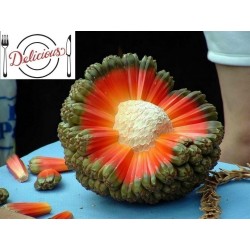
Tahitian Screwpine Seeds (Pandanus tectorius)
Price for Package of 2 seeds.
Pandanus tectorius is a species of Pandanus (screwpine) that is native to Malesia, eastern Australia, and the Pacific Islands. Common names in English include Tahitian screwpine[2] and thatch screwpine. P. tectorius is a tree that grows to 4–14 m (13–46 ft) tall. The single trunk is spiny and forks at a height
Pandanus tectorius is a species of Pandanus (screwpine) that is native to Malesia, eastern Australia, and the Pacific Islands. Common names in English include Tahitian screwpine[2] and thatch screwpine.
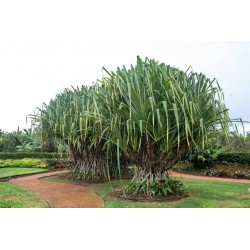
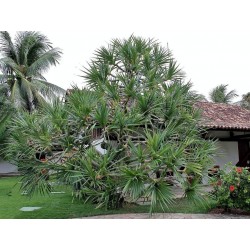
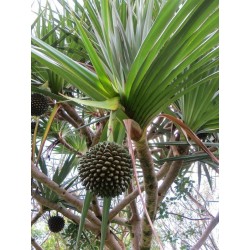
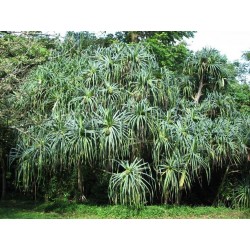
P. tectorius is a tree that grows to 4–14 m (13–46 ft) tall. The single trunk is spiny and forks at a height of 4–8 metres (13–26 ft).[4] It is supported by prop roots that firmly anchor the tree to the ground. Its leaves are usually 90–150 cm (3.0–4.9 ft) long and 5–7 cm (2.0–2.8 in) wide with saw-like margins.
Flowers
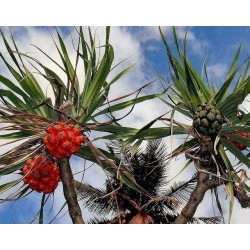
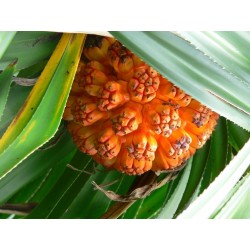
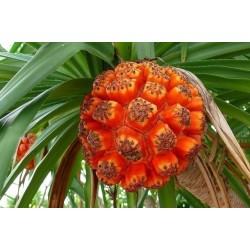
Pandanus tectorius is dioecious, with very different male and female flowers. Male flowers are small, fragrant, form clusters or racemes, and short lived, lasting only a single day. Female flowers resemble pineapples.
Fruit
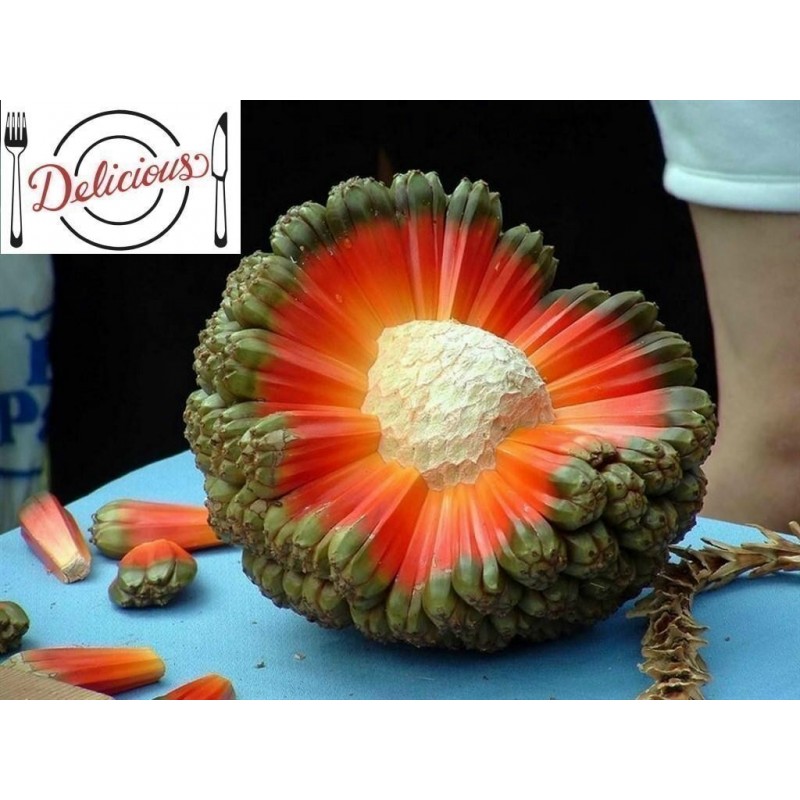
The fruit of P. tectorius is either ovoid, ellipsoid, subglobose or globose with a diameter of 4–20 cm (1.6–7.9 in) and a length of 8–30 cm (3.1–11.8 in). The fruit is made up of 38–200 wedge-like phalanges, which have an outer fibrous husk. Phalanges contain two seeds on average, with a maximum of eight reported. The phalanges are buoyant, and the seeds within them can remain viable for many months while being transported by ocean currents.
Uses
The fruit can be eaten raw or cooked and is a major source of food in Micronesia, especially in the atolls. It is also one of the traditional foods of Maldivian cuisine. The fibrous nature of the fruit also serves as a natural dental floss. It is also used in Samoan culture as a Ula Fala, a necklace made out of the dried fruit painted in red and is worn by the Matai during special occasions and functions.
The tree's leaves are often used as flavoring for sweet dishes such as kaya jam, and are also said to have medicinal properties. It is also used in Sri Lankan cookery, where the leaves are used to flavor a variety of curries. Leaves were used by the Polynesians to make baskets, mats, outrigger canoe sails, thatch roofs, and grass skirts.
A large shrub or small tree of immense cultural, health, and economic importance in the Pacific, it is second only to coconut on atolls. It grows wild mainly in semi-natural vegetation in littoral habitats throughout the tropical and subtropical Pacific, where it can withstand drought, strong winds, and salt spray. It propagates readily from seed, but it is also widely propagated from branch cuttings by local people for farms and home gardens. It grows fairly quickly, and all parts are used, from the nutritious fruits of edible varieties to the poles and branches in construction to the leaves for weaving and garlands. The plant is prominent in Pacific culture and tradition, including local medicine.
Hundreds of cultivated varieties are known by their local names and characteristics of fruits, branches, and leaves. At present, there is evidence that this diversity is declining, with certain varieties becoming difficult to find. The reasons include less replanting, deforestation, fire, flagging interest by the new generation, and rapid population growth leading to urbanization.
Habitat
Pandanus tectorius naturally grows in coastal regions, such as on mangrove margins and beaches,
at elevations from sea level to 610 m (2,000 ft).[5] It requires 1,500–4,000 mm (59–157 in) of annual rainfall. Thatch Screwpine is well adapted to grow in the many soil types present on coasts, including quartz sand, coral sand, and peat, as well as in limestone and basalt. P. tectorius is salt and wind tolerant and favors slightly acidic to basic soil (pH of 6-10). It prefers to grow in full sunlight, but grows well with 30-50% shade.
Range
Pandanus tectorius occurs from Port Macquarie in New South Wales to northern Queensland, Australia and Indonesia east through the islands of the tropical Pacific Ocean to Hawaii.[6] Its exact native range is unknown due to extensive cultivation; it may be an early Polynesian introduction to many of the more isolated Pacific islands on which it occurs. P. tectorius is known to have predated human settlement on Hawaii due to seed and pollen samples taken from Kauaʻi's Makauwahi Cave.
Culture
The seal of Punahou School in Honolulu, Hawaii features the hala tree, in part because lauhala, the art of weaving with the leaves of that tree, is pivotal to the history of the island, with everything from houses to pillows being made in this fashion. Local legend tells of an aged Hawaiian couple who lived long ago above the present Punahou campus, and had to travel far for water. They prayed each night for a spring, but to no avail. Finally one night, in a dream answering their prayers, they were told to uproot the stump of an old hala tree. They did as they were told and found a spring of clear, sweet water, which they named Ka Punahou, the New Spring. According to legend, Punahou School's lily pond is fed by this same spring.
 Reviews (0)
Tahitian Screwpine Seeds (Pandanus tectorius)
Price for Package of 2 seeds.
Pandanus tectorius is a species of Pandanus (screwpine) that is native to Malesia, eastern Australia, and the Pacific Islands. Common names in English include Tahitian screwpine[2] and thatch screwpine. P. tectorius is a tree that grows to 4–14 m (13–46 ft) tall. The single trunk is spiny and forks at a height