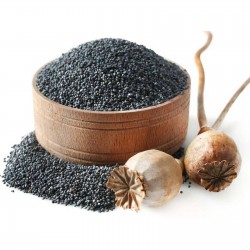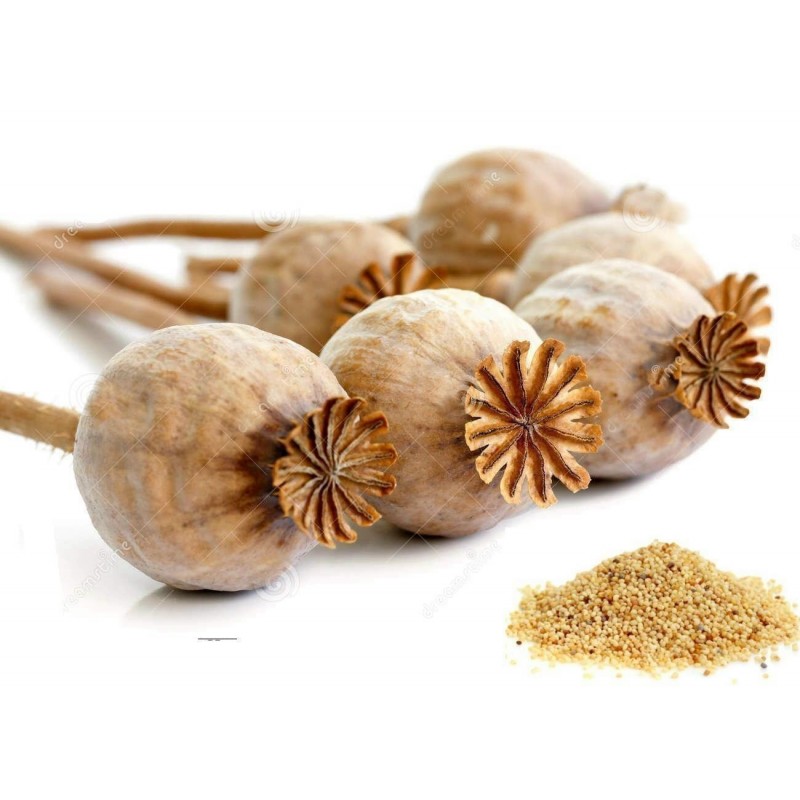
Papaver somniferum, the Opium poppy, is the species of plant from which opium and poppy seeds are derived. Opium is the source of many narcotics, including morphine (and its derivative heroin)
Papaver somniferum, the Opium poppy, is the species of plant from which opium and poppy seeds are derived. Opium is the source of many narcotics, including morphine (and its derivative heroin), thebaine, codeine, papaverine, and noscapine. The Latin botanical name means the "sleep-bringing poppy", referring to the sedative properties of some of these opiates.
The opium poppy is the only species of Papaveraceae that is an agricultural crop grown on a large scale. Other species, Papaver rhoeas, and Papaver argemone are important agricultural weeds and may be mistaken for the crop.
It is also valuable for ornamental purposes and has been known as the "common garden poppy", referencing all the group of poppy plants.
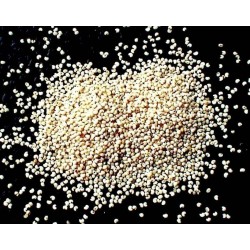
Poppy seeds of Papaver somniferum are an important food item and the source of poppyseed oil, healthy edible oil that has many uses.
Description
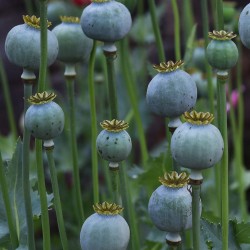
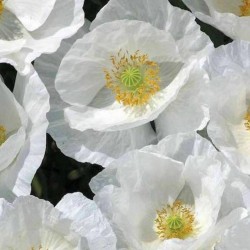
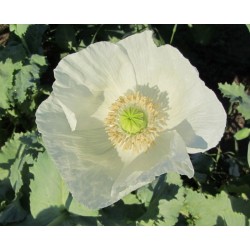
Papaver somniferum is an annual herb growing to 100cm. All parts of the plant are strongly glaucous, giving a greyish-green appearance, and the stem and leaves are sparsely covered with coarse hairs. The leaves are lobed and clasp the stem at the base. The flowers are up to 120mm diameter, normally with four white, mauve or red petals, sometimes with dark markings at the base. The fruit is a hairless, rounded capsule topped with 12–18 radiating stigmatic rays. All parts of the plant exude white latex when wounded.
History
Use of the opium poppy predates written history. Images of opium poppies have been found in ancient Sumerian artifacts (circa 4000 BC). The making and use of opium was known to the ancient Minoans.[7] Its sap was later named opion by the ancient Greeks, from whence it gained its modern name of opium.
Opium was used for treating asthma, stomach illnesses, and bad eyesight.
The First and Second Opium Wars among China, the British Empire and France took place in the late 1830s through the early 1860s, when the Chinese attempted to stop western traders smuggling opium into their country.
Many modern writers, particularly in the 19th century, have written on the opium poppy and its effects, notably Thomas de Quincey in Confessions of an English Opium-Eater
The French Romantic composer Hector Berlioz used opium for inspiration, subsequently producing his Symphonie Fantastique. In this work, a young artist overdoses on opium and experiences a series of visions of his unrequited love.
Opium poppies (flower and fruit) appear on the coat of arms of the Royal College of Anaesthetists.
Legality
Opium poppy cultivation in the United Kingdom does not require a license, but extracting opium for medicinal products does.
In Italy, it is forbidden to grow P. somniferum to extract the alkaloids, but small numbers of specimens can be grown without special permits for purely ornamental purposes.
Unlike in its neighboring countries Austria and Switzerland, where opium poppy is still cultivated legally, it has been delegalized in Western Germany after World War II, extending this regulation after German reunification in 1990 also to territories of the former GDR, where opium poppy cultivation had remained legal until then.
In the United Arab Emirates, where the drug law is especially stern, at least one man was reported to have been imprisoned for possessing poppy seeds obtained from a bread roll.[9]
In New Zealand, section 9(4) of the Misuse of Drugs Act states, "It shall be a defense to a charge under subsection (1) [Cultivation of prohibited plants] if the person charged proves that the prohibited plant to which the charge relates was of the species Papaver somniferum and that it was not intended to be a source of any controlled drug or that it was not being developed as a strain from which a controlled drug could be produced."
In northern Burma, opium bans have ended a century-old tradition of growing poppy. Between 20,000 and 30,000 ex-poppy farmers left the Kokang region as a result of the ban in 2002.[11] People from the Wa region, where the ban was implemented in 2005, fled to areas where growing opium is still possible.
In the United States, opium is listed as a Schedule II controlled substance by the Drug Enforcement Administration. In addition, "Opium poppy and poppy straw" are also prohibited.[12] However, this is not typically enforced for poppies grown or sold for ornamental or food purposes.[4] Though the opium poppy is legal for culinary or æsthetic reasons, poppies were once grown as a cash crop by farmers in California; the law of poppy cultivation in the United States is somewhat ambiguous.
The reason for the ambiguity is because The Opium Poppy Control Act of 1942 (now repealed),[14][15][16] stated that any opium poppy should be declared illegal, even if the farmers were issued a state permit. § 3 of The Opium Poppy Control Act stated:
It shall be unlawful for any person who is not the holder of a license authorizing him to produce the opium poppy, duly issued to him by the Secretary of the Treasury in accordance with the provisions of this Act, to produce the opium poppy, or to permit the production of the opium poppy in or upon any place owned, occupied, used, or controlled by him.
This led to the Poppy Rebellion, and to the Narcotics Bureau arresting anyone planting opium poppies and forcing the destruction of poppy fields of anyone who defied the prohibition of poppy cultivation. Though the press of those days favored the Federal Bureau of Narcotics, the state of California supported the farmers who grew opium poppies for their seeds for uses in foods such as poppyseed muffins. Today, this area of law has remained vague and remains somewhat controversial in the United States. The Opium Poppy Control Act of 1942 was repealed on 27 October 1970.
The seeds themselves contain very small amounts of opiates,[4] and have no measurable narcotic effect in small quantities. See poppy tea. However, the television show MythBusters demonstrated that one could test positive for narcotics after consuming four poppy seed bagels. On the show Brainiac: Science Abuse, subjects tested positive after eating only two poppy seed bagels.
Medicine
Australia (Tasmania), Turkey, and India are the major producers of the poppy for medicinal purposes and poppy-based drugs, such as morphine or codeine.[23] The USA has a policy of sourcing 80% of its narcotic raw materials from the traditional producers, India, and Turkey.
A recent initiative to extend opium production for medicinal purposes called Poppy for Medicine was launched by The Senlis Council which proposes that Afghanistan could produce medicinal opium under a scheme similar to that operating in Turkey and India.[25] The Council proposes licensing poppy production in Afghanistan, within an integrated control system supported by the Afghan government and its international allies, to promote economic growth in the country, create vital drugs and combat poverty and the diversion of illegal opium to drug traffickers and terrorist elements. Interestingly, Senlis is on record advocating the reintroduction of poppy into areas of Afghanistan, specifically Kunduz, which has been poppy free for some time.
The Senlis proposal is based in part on the assertion that there is an acute global shortage of opium poppy-based medicines some of which (morphine) are on the World Health Organisation's list of essential drugs as they are the most effective way of relieving severe pain. This assertion is contradicted by the International Narcotics Control Board (INCB), the "independent and quasi-judicial control organ monitoring the implementation of the United Nations drug control conventions". INCB reports that the supply of opiates is greatly in excess of demand.
In March 2010, researchers from the Department of Biological Sciences at the University of Calgary published an article in Nature Chemical Biology about their discovery of two enzymes and their encoding genes, thebaine 6-O-demethylase (T6ODM) and codeine O-demethylase (CODM), involved in morphine biosynthesis derived from the opium poppy.[27] The enzymes were identified as non-heme dioxygenases and were isolated using functional genomics.[27] Codeine O-demethylase produces the enzyme that converts codeine into morphine.
Medical cultivation in the UK
In late 2006, the British government permitted the pharmaceutical company Macfarlan Smith (a Johnson Matthey company, FTSE 100) to cultivate opium poppies in England for medicinal reasons[29] after Macfarlan Smith's primary source, India, decided to increase the price of export opium latex. This move is well received by British farmers,[citation needed] with a major opium poppy field based in Didcot, England. As of 2012, they were growing in Dorset, Hampshire, Oxfordshire and Lincolnshire as a spring-sown break crop recognized under the single payment scheme farm subsidy.[30] The Office of Fair Trading has alerted the government to their monopoly position on growing in the UK and worldwide production of diamorphine and recommended consideration.[29] The governments response advocated the status quo, being concerned interference might cause the company to stop production.
Use as food
The opium poppy is the source of two food ingredients: poppy seed and poppyseed oil. The seeds contain very low levels of opiates,[4] and the oil extracted from them contains even less. Both the oil and the seed residue also have commercial uses.
Poppy seeds
Poppy seeds are commonly used in cuisine from many different cultures. They can be dry roasted and ground to be used in wet curry (curry paste) or dry curry. They have a creamy and nut-like flavor, and when used with ground coconut, the seeds provide a unique and flavor-rich curry base.
Ornamental cultivation
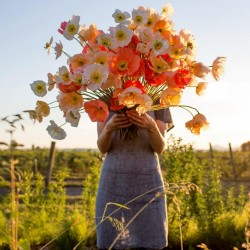
Once known as the "common garden poppy", live plants and seeds of the opium poppy are widely sold by seed companies and nurseries in most of the western world, including the United States. Poppies are sought after by gardeners for the vivid coloration of the blooms, the hardiness and reliability of the poppy plants, the exotic chocolate-vegetal fragrance note of some cultivars, and the ease of growing the plants from purchased flats of seedlings or by direct sowing of the seed. Poppyseed pods are also sold for dried flower arrangements.
Since "opium poppy and poppy straw" are listed in Schedule II of the United States' Controlled Substances Act, a DEA license may be required to grow poppies in ornamental or display gardens. In fact, the legal status of strictly ornamental poppy gardens is more nuanced, and destruction of ornamental poppy installations or prosecution of gardeners (except those caught extracting opium via capsule scarification or tea extraction) are virtually unheard of.[4] During the early spring, opium poppies can be seen flowering in gardens throughout North America and Europe, and beautiful displays are found in many private planters, as well as in public botanical and museum gardens (e.g., United States Botanical Garden, Missouri Botanical Garden, North Carolina Botanical Garden).
Many countries grow the plants, and some rely heavily on the commercial production of the drug as a major source of income. As an additional source of profit, the seeds of the same plants are sold for use in foods, so the cultivation of the plant is a significant source of income. This international trade in seeds of P. somniferum was addressed by a UN resolution "to fight the international trade in illicit opium poppy seeds" on 28 July 1998.
Popular culture
In the 19th century Thomas de Quincey wrote Confessions of an English Opium-Eater (1821). A book on Opium and allegedly the first book in the series of drug-addiction literature.
Recently, a feature film entitled The Opium Eater was released exploring the life of Eric Detzer and how he would go about acquiring opium poppies from flower shops and gardens in the Pacific Northwest (north of Seattle) to feed his addiction. This true story is based on an autobiography, Poppies: Odyssey of an Opium Eater written by Detzer, and starring David Bertelsen. Since the festival release of this film in Breckenridge, CO, eBay has stopped allowing the sale of opium poppy pods on their auction site. This may also be attributed to the death of a Colorado teen, who overdosed on opium tea around the same time.
What may be the most well known literary use of the poppy occurs both in L. Frank Baum's The Wonderful Wizard of Oz and in MGM's classic 1939 film based on the novel.
In the novel, while on their way to the Emerald City, Dorothy, the Scarecrow, the Tin Man, and the Cowardly Lion walk through a field of poppies, and both Dorothy and the Lion mysteriously fall asleep. The Scarecrow and the Tin Man, not being made of flesh and blood, are unaffected. They carry Dorothy to safety and place her on the ground beyond the poppy field. While they are considering how to help the Lion, a field mouse runs in front of them, fleeing a cougar. The Tin Man beheads the cougar with his axe, and the field mouse pledges her eternal gratitude. Being the Queen of the Field Mice, she gathers all her subjects together. The Tin Man cuts down several trees, and builds a wagon. The Lion is pushed onto it, and the mice pull the wagon safely out of the poppy field.
In the 1939 film, the sequence is considerably altered. The poppy field is conjured up by the Wicked Witch of the West, and it appears directly in front of the Emerald City, preventing the four travelers from reaching it. As in the novel, Dorothy and the Cowardly Lion fall asleep, but in a direct reversal of the book, the Scarecrow and the Tin Man are unable to carry Dorothy. Glinda, who has been watching over them, conjures up a snowfall which kills the poppies' narcotic power and enables Dorothy and the Lion to awaken. Unfortunately, the Tin Man has been weeping in despair, and the combination of his tears and the wet snow has caused him to rust. After he is oiled by Dorothy, the four skip happily toward the Emerald City.
In Baum's other Oz books, Oz's ruler, Princess Ozma, is often shown wearing poppies in her hair as decoration.

Parametry
Mohlo by vás také zajímat

 Reviews (0)
Papaver somniferum, the Opium poppy, is the species of plant from which opium and poppy seeds are derived. Opium is the source of many narcotics, including morphine (and its derivative heroin)