

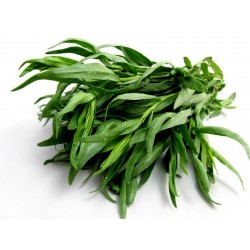
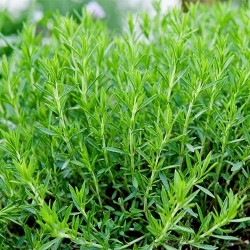
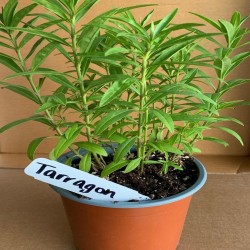
Tarragon (Artemisia dracunculus), also known as estragon, is a species of perennial herb in the sunflower family. It is widespread in the wild across much of Eurasia and North America
Tarragon (Artemisia dracunculus), also known as estragon, is a species of perennial herb in the sunflower family. It is widespread in the wild across much of Eurasia and North America and is cultivated for culinary and medicinal purposes.
One subspecies, Artemisia dracunculus var. sativa, is cultivated for use of the leaves as an aromatic culinary herb. In some other subspecies, the characteristic aroma is largely absent. The species is polymorphic.[7] Informal names for distinguishing the variations include "French tarragon" (best for culinary use), "Russian tarragon", and "wild tarragon" (covers various states).
Tarragon grows to 120–150 cm (4–5 ft) tall, with slender branches. The leaves are lanceolate, 2–8 cm (1–3 in) long and 2–10 mm (0.1–0.4 in) broad, glossy green, with an entire margin. The flowers are produced in small capitula 2–4 mm (0.1–0.2 in) diameter, each capitulum containing up to 40 yellow or greenish-yellow florets. French tarragon, however, seldom produces any flowers (or seeds).[8] Some tarragon plants produce seeds that are generally only sterile. Others produce viable seeds. Tarragon has rhizomatous roots that it uses to spread and readily reproduce.
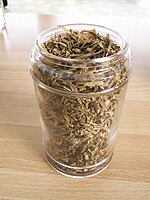
French tarragon is the variety used for cooking in the kitchen[9] and is not grown from seed, as the flowers are sterile; instead it is propagated by root division.
Russian tarragon (A. dracunculoides L.) can be grown from seed but is much weaker in flavor when compared to the French variety.[8] However, Russian tarragon is a far more hardy and vigorous plant, spreading at the roots and growing over a meter tall. This tarragon actually prefers poor soils and happily tolerates drought and neglect. It is not as strongly aromatic and flavorsome as its French cousin, but it produces many more leaves from early spring onwards that are mild and good in salads and cooked food. Russian tarragon loses what flavor it has as it ages and is widely considered useless as a culinary herb, though it is sometimes used in crafts. The young stems in early spring can be cooked as an asparagus substitute. Horticulturists recommend that Russian tarragon be grown indoors from seed and planted out in the summer. The spreading plants can be divided easily.
A better substitute for French tarragon is Spanish tarragon (Tagetes lucida), also known as Mexican mint marigold, Mexican tarragon, Texas tarragon, or winter tarragon.[10] It is much more reminiscent of French tarragon, with a hint of anise. Although not in the same genus as the other tarragons, Spanish tarragon has a stronger flavor than Russian tarragon that does not diminish significantly with age.
Tarragon has an aromatic property reminiscent of anise, due to the presence of estragole, a known carcinogen and teratogen in mice. The European Union investigation revealed that the danger of estragole is minimal even at 100–1,000 times the typical consumption seen in humans.[11] Estragole concentration in fresh tarragon leaves is about 2900 mg/kg.[12]
Tarragon is one of the four fines herbes of French cooking, and is particularly suitable for chicken, fish, and egg dishes. Tarragon is the main flavoring component of Béarnaise sauce. Fresh, lightly bruised sprigs of tarragon are steeped in vinegar to produce tarragon vinegar.
Tarragon is used to flavor a popular carbonated soft drink in the countries of Armenia, Azerbaijan, Georgia (where it originally comes from) and, by extension, Russia, Ukraine and Kazakhstan. The drink, named Tarkhuna, is made out of sugary tarragon concentrate and colored bright green.
In Iran, tarragon is used as a side dish in sabzi khordan (fresh herbs), or in stews and in Persian style pickles, particularly khiar shoor (pickled cucumbers).
In Slovenia, tarragon is used in a variation of the traditional nut roll sweet cake, called potica. In Hungary a popular kind of chicken soup is flavored with tarragon.
cis-Pellitorin, an isobutyramide eliciting a pungent taste, has been isolated from the tarragon plant.[13]
A. dracunculus oil contained predominantly phenylpropanoids such as methyl chavicol (16.2%) and methyl eugenol (35.8%).[14] Gas chromatography/mass spectrometry analysis of the essential oil revealed the presence of trans-anethole (21.1%), α-trans-ocimene (20.6%), limonene (12.4%), α-pinene (5.1%), allo-ocimene (4.8%), methyl eugenol (2.2%), β-pinene (0.8%), α-terpinolene (0.5%), bornyl acetate (0.5%) and bicyclogermacrene(0.5%) as the main components.[15] The organic compound capillin was initially isolated from Artemisia capillaris in 1956.
Parametry
 Reviews (0)
Tarragon (Artemisia dracunculus), also known as estragon, is a species of perennial herb in the sunflower family. It is widespread in the wild across much of Eurasia and North America